



Healthcare leaders are being asked to make long-term decisions in an environment defined by uncertainty.
Service line expansion, provider recruitment, facility planning, and access strategies often require commitments years in advance — yet many planning decisions are often informed by historical utilization data, which explains past performance but offers limited visibility into future demand. While looking backward explains what has already happened, it does little to prepare healthcare organizations for what’s coming next.
As markets shift, populations age, chronic conditions rise, and care continues moving to outpatient settings, the ability to anticipate future demand has become a strategic necessity.
That’s where forecasting data helps healthcare organizations plan with greater clarity and confidence.
Moving from Retrospective Reporting to Predictive Planning
Traditional market analysis focuses on past volumes, past utilization, and past trends. Forecasting data takes a different approach — helping healthcare organizations understand how demand is expected to change over the next several years.
By projecting patient volume, service line growth, payer mix shifts, and population health trends, forecasting data allows leaders to plan proactively rather than reactively. It enables organizations to align resources, staffing, and access strategies with where demand is headed — not where it has been.
The result is more confident planning, better capital allocation, and fewer surprises as market dynamics evolve.
In practice, forecasting data becomes most valuable when applied to the real planning questions healthcare leaders face today. Below are a few primary ways healthcare organizations utilize forecasting data to support strategic planning:
Demand Forecasting and Service Line Growth
One of the most immediate ways healthcare organizations can apply forecasting data is to better understand how demand is expected to change across service lines and geographies. In doing so, leaders begin asking questions such as:
- Which service lines and subspecialties are projected to grow over the next 1–5 years?
- How will inpatient versus outpatient demand shift?
- Which procedures represent the greatest growth opportunity?
- Which communities will require additional access to care?
Intellimed’s Forecasting Data answers these questions by projecting future patient volume and identifying where growth is expected to occur — by service line, geography, and site of care. This insight supports smarter service line planning, helps prioritize capital investments, and informs decisions around facility expansion or consolidation.
Rather than relying on assumptions or historical averages, healthcare leaders gain a clearer picture of where growth is actually expected.
Population Health and Provider Needs
Forecasting data becomes even more powerful when paired with population health insights.
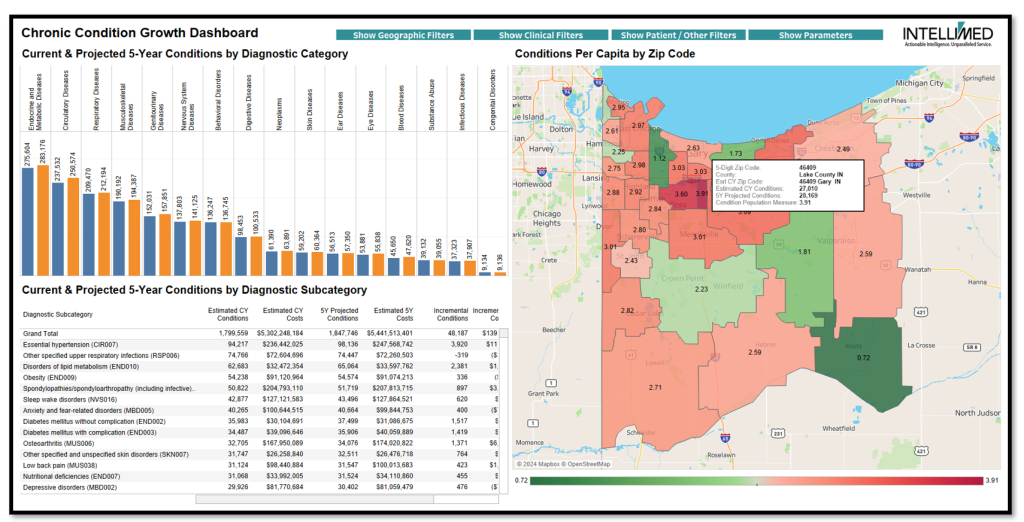
Chronic conditions continue to drive a significant share of healthcare demand, and their prevalence is not evenly distributed across markets. Understanding which conditions are growing — and where — is essential for planning provider coverage, access strategies, and long-term care delivery models.
Forecasting data helps healthcare organizations address several key population health and provider planning challenges, including:
- Identifying chronic conditions that are increasing in prevalence
- Pinpointing communities with the highest concentration of need
- Understanding provider gaps by specialty or geography
- Improving access to care for underserved or fast-growing populations
By anticipating future population health needs, organizations can align provider recruitment, care models, and outreach strategies with projected demand — rather than responding after gaps already exist.
Turning Forecasts into Actionable Strategy
Forecasting data is only valuable if it informs real decisions.
When applied effectively, it supports:
- Service line development: Prioritizing growth opportunities backed by projected demand
- Provider planning: Recruiting the right specialists in the right locations
- Emergency department readiness: Anticipating fluctuations in ED visits to support staffing and resource allocation
- Discharge and capacity planning: Aligning downstream services with projected patient flow
- Market expansion decisions: Identifying growing communities that require additional access points
This level of foresight helps leadership teams plan with greater precision and confidence, reducing risk while supporting sustainable growth.
The Bottom Line: Planning Without Forecasting Increases Risk
Healthcare organizations can no longer afford to plan solely based on historical trends. Markets are changing too quickly, and the cost of misalignment — whether in staffing, facilities, or service offerings — continues to rise.
Forecasting data gives leaders the ability to anticipate demand, understand how their market is evolving, and prepare for the years ahead with clarity.
The question isn’t whether to plan for the future — it’s whether you have the insight needed to do it effectively.
Explore how Intellimed’s Forecasting Data supports long-term planning and strategic growth.
Forecasting Data: Frequently Asked Questions
How does forecasting data differ from traditional market analysis?
Traditional market analysis looks at past utilization and performance. Forecasting data projects future demand, helping healthcare organizations anticipate changes in patient volume, service line growth, and population health trends.
How far into the future can healthcare demand be forecasted?
Forecasting models typically project demand one to five years into the future, allowing organizations to support both near-term planning and longer-term strategic initiatives.
How can forecasting data support provider recruitment?
By identifying growing service lines, chronic condition trends, and geographic demand shifts, forecasting data helps healthcare organizations recruit providers where they will be most needed.
Who benefits most from forecasting data?
Strategy, finance, operations, and clinical leadership teams all benefit from forecasting data when planning service lines, facilities, staffing, and access strategies.
Copyright 2025 Intellimed International Corporation. Intellimed, IntelliMarket and IntelliClient are registered service marks of Intellimed International Corporation. All Rights Reserved.