


Healthcare organizations operate in increasingly complex and competitive markets. To make informed strategic decisions, hospitals and health systems rely on healthcare market intelligence — a combination of data sources and analytic insights that help leaders understand how patients access care, how markets are evolving, and where opportunities for growth exist.
Healthcare market intelligence often incorporates datasets such as claims data, hospital discharge data, demographic insights, and forecasting analytics. When analyzed together, these datasets provide a broader view of patient movement, service line demand, and competitive market dynamics that may not be visible through internal data alone.
By transforming complex healthcare data into meaningful insights, healthcare leaders can better understand their markets and make more informed decisions that support long-term strategy and improved access to care.
Why Healthcare Market Intelligence Matters
For healthcare organizations, understanding what is happening within their market environment is essential for effective planning.
Many hospitals rely heavily on internal data sources such as electronic health records or financial reports. While valuable, these internal datasets only provide a partial view of what is happening across a healthcare market.
Healthcare data and market intelligence expand that perspective by incorporating external datasets that reveal how patients interact with providers across an entire region.
With access to comprehensive market data, healthcare leaders can begin to answer important strategic questions such as:
- Where are patients leaving the market for care?
- Which competitors are gaining market share?
- Which service lines are experiencing increasing demand?
- Where may gaps in access to care be developing?
These insights allow healthcare organizations to move beyond reactive decision-making and instead take a more proactive approach to strategic planning and market development.
Key Data Sources Behind Healthcare Market Intelligence
Healthcare market intelligence is built on several types of healthcare data, each providing unique insights into market activity and patient utilization patterns.
All-Payer Claims Data
Claims data provides insight into how patients access care across multiple payers and providers. By analyzing claims activity across a region, healthcare organizations can evaluate referral patterns, understand patient movement, and assess their market share relative to competing providers.
Hospital Discharge Data
Hospital discharge data provides insight into inpatient and outpatient utilization patterns across healthcare markets. By analyzing where patients receive care within a region, healthcare organizations can better understand service demand and regional care patterns.
Demographic and Population Insights
Demographic data helps healthcare organizations evaluate population trends, including aging populations, regional population growth, and shifts in healthcare demand. These insights support long-term strategic planning and service line development.
Forecasting Analytics
Healthcare forecasting models combine historical utilization data with demographic and population trends to estimate future demand for healthcare services. These projections help healthcare organizations plan for service line expansion and anticipate future community healthcare needs.
When these datasets are analyzed together, healthcare leaders gain a much clearer view of how their markets are evolving and where opportunities for growth may exist.
Translating Healthcare Data Into Strategic Insight
While access to healthcare data is valuable, the true impact of healthcare market intelligence comes from the ability to translate that data into meaningful insights.
Advanced analytic methodologies help healthcare organizations identify patterns in patient movement, quantify market share, and evaluate service line performance across a region.
These insights can support a wide range of strategic initiatives, including:
- service line planning and expansion
- physician recruitment strategies
- improving access to care within communities
- evaluating competitive positioning within a healthcare market
By transforming complex datasets into actionable intelligence, healthcare leaders are better equipped to make informed decisions that support both organizational sustainability and patient care access.
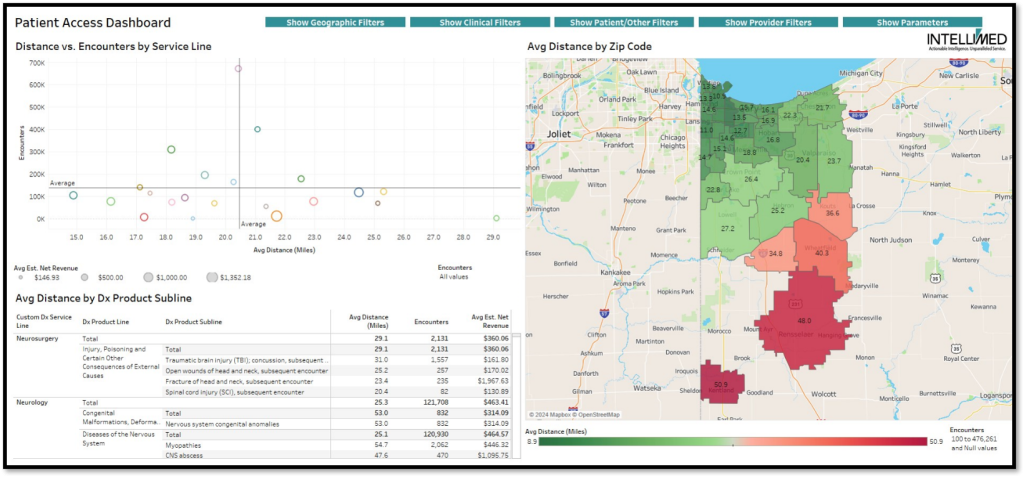
Supporting Strategic Healthcare Decisions with Data
Understanding healthcare markets requires more than simply collecting data. It requires the ability to interpret complex datasets and translate them into insights that support effective strategic planning.
For more than four decades, Intellimed® has worked with hospitals, health systems, physician groups, and payers across the United States to provide healthcare market intelligence and data analytics that help healthcare organizations better understand patient movement, evaluate market share, and identify opportunities for strategic growth.
By combining comprehensive healthcare datasets with advanced analytic methodologies, Intellimed helps healthcare leaders gain clearer visibility into their markets and make more informed decisions about service line planning, physician recruitment, and long-term strategy.
Frequently Asked Questions About Healthcare Market Intelligence
How can healthcare leaders use market intelligence to inform strategic planning?
Healthcare data and market intelligence provide leaders with a broader view of patient utilization patterns, competitive market activity, and emerging demand trends. These insights help inform decisions related to service line development, physician recruitment, and long-term strategic planning.
How does healthcare market intelligence support service line strategy?
By analyzing utilization patterns, referral flows, and regional demand trends, healthcare organizations can identify service lines with strong growth potential and better align investments with evolving community needs.
What role does patient movement analysis play in healthcare strategy?
Analyzing patient movement helps healthcare leaders understand how patients access care across a region, including where patients may seek care outside their primary health system. These insights can inform strategies to improve access to care, strengthen referral networks, and retain patients within a healthcare system.
How do healthcare organizations evaluate market share within their region?
Healthcare market share is typically evaluated using claims data and other utilization datasets that reveal where patients receive care across a defined geographic area. Understanding these patterns helps organizations assess their competitive position and identify opportunities for growth.
Why is external market data important alongside internal hospital data?
While internal data provides insight into an organization’s own patient activity, external market data provides a broader view of how patients interact with providers across an entire region. Combining these perspectives allows healthcare leaders to make more informed strategic decisions.
Copyright 2026 Intellimed International Corporation. Intellimed, IntelliMarket and IntelliClient are registered service marks of Intellimed International Corporation. All Rights Reserved.